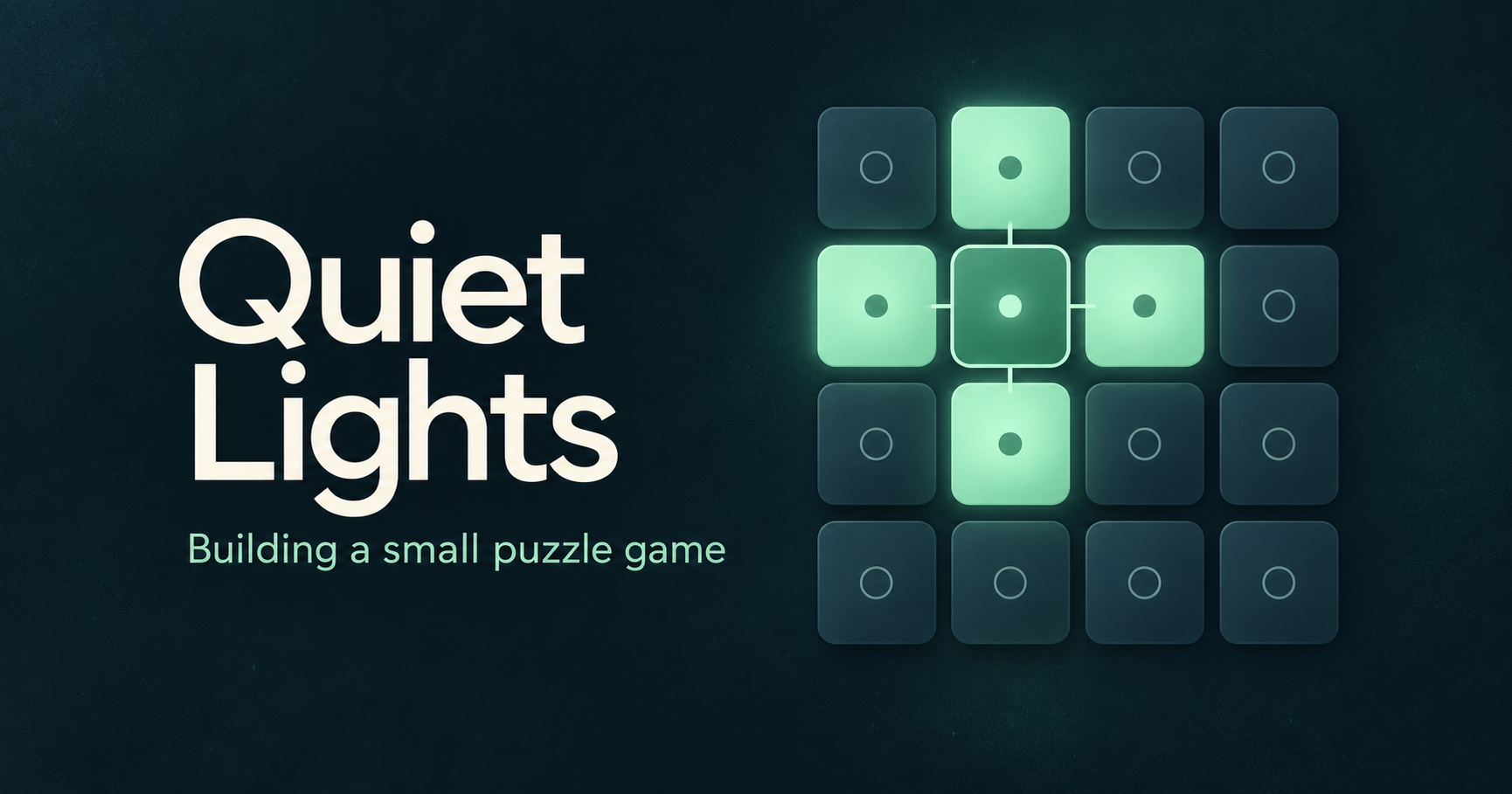
I’ve been building a small Android puzzle game called Quiet Lights.
The idea started with a waiting room: something you could pick up for a few minutes, put down when your name was called, and come back to without remembering a story or a complicated set of rules.
That pushed the first version toward one screen, simple graphics, and comfortable tap targets on a phone or tablet.
The rule is familiar: tap a tile to flip it and its neighbors above, below, left, and right. Turn every light off to solve the board.
The rules were straightforward to implement. Figuring out whether the puzzles felt good has taken more work.
If you’d like to try it, the Quiet Lights playtest page has a short gameplay clip and instructions for joining the Android test. I’m looking for more people to play a few puzzles and tell me what they notice.
What I Wanted to Build
The first set had twelve puzzles across 3×3, 4×4, and 5×5 boards. There was no timer. You could undo a move, restart, or choose another puzzle.
I wanted the levels to be easy to define and extend. Each one starts with a dark board and a small set of taps that generates its initial pattern. Applying those same taps again clears it.
That gives me a solvable board by construction. Whether it is interesting, whether the seed is a shortest solution, and where it belongs in the sequence still need checking.
The rest of the app stayed deliberately modest: local progress and preferences, optional haptics, no in-game account, no ads, and no backend. The game works offline after installation.
Where the Difficulty Jumped
One tester noticed a steep increase in challenge around the original eighth puzzle. They also wanted to know how their solution compared with the best possible result, or with other players.
I added an exact solver and checked the original levels. The two puzzles on either side of that reported jump both had a four-move minimum.
The move count was the same, but the taps interacted differently.
In the earlier puzzle, the four solution taps clear independent groups. In the next one, their effects overlap. A correct move can turn a dark tile back on before a later move turns it off again.
Both take four taps, but clearing independent groups gives a more obvious sense of progress. Overlap asks the player to accept that a useful move can temporarily make part of the board look worse.
That gave me a design hypothesis: the transition needed more practice with interacting effects, rather than simply a different number of moves.
The solver gave me evidence to work with. I still need players to tell me whether that explains the difficulty they experienced.
Two More Puzzles, Same Rules
I added two training puzzles before that transition, bringing the game to fourteen puzzles.
Shared light introduces one shared tile in a three-tap solution. Part of the board remains an independent little group, while the overlapping pair asks the player to accept a light coming back on temporarily.
Quiet echoes repeats that pattern in two places. The idea is to let the player recognize and reuse something before combining more interactions in the next puzzle.
Both use the existing controls and rules. They appear in the ordinary puzzle sequence, without a separate tutorial mode.
I’ve played them in the emulator and like how they fit. Now I want to see whether other players recognize the pattern and find the transition less abrupt.
Answering “How Did I Do?”
The other part of that feedback led to the completion screen.
After a solve, Quiet Lights now shows the moves used, the puzzle’s exact minimum, and the player’s saved personal best. You can try again immediately or move on at any score.
The counting rule follows the existing undo history: undo removes a move, and restart begins a new attempt. This compares the final sequence you kept, rather than every experimental tap you made along the way.
There is no average-player comparison yet. I don’t have that dataset, and local personal bests already give players something useful to work toward.
That addition also exposed a small layout problem: making room for the scores caused the completed board to shrink. It worked, but the change was distracting. Reserving the results space during play lets the board keep its size and position when the last light goes out.
It was a small change, but the completed board felt noticeably better without that shift.
Making Each Tap Easier to Read
Another tester suggested showing the shape affected by a tap.
I prototyped a brief outline around every tile that changes. It fades over about 180 milliseconds, accepts another tap immediately, and is suppressed when the device requests reduced motion. The outline stays distinct from whether a tile is lit or dark.
I liked it in emulator testing and prepared it for the next tester build. It reinforces the rule the player is already learning.
A different suggestion was to introduce colored tiles with different behavior, perhaps requiring several hits to clear. I’ve recorded that for later. For this initial testing phase, I want to understand the current mechanic and challenge curve before introducing another one.
What I Need Next
Quiet Lights has made the trip from browser playtesting to the Android emulator, a physical tablet, and Google Play testing. Along the way it acquired the ordinary things an app needs: saved state, an icon and splash screen, signing, a privacy policy, and release notes.
The current hurdle is familiar from Range Session Tracker: getting more people to try it.
I put together a small website, hosted on Cloudflare, with actual gameplay and instructions for joining the test. That gives me somewhere useful to send people instead of explaining the enrollment process in every message.
If you have an Android phone or tablet and enjoy small puzzles, join the Quiet Lights playtest. The page walks through joining the Google Group, opting into the test, and installing through Google Play. Use the same Google account for each step.
You don’t need to solve everything or write a formal review. Tell me where the challenge jumps, which interactions feel unclear, or what makes you want to try a board again.
The app runs, the first feedback has already changed it, and the next useful step is more people playing. I’d love your help with that.
Comments
Join the discussionFor reduced motion, I would try a static outline until the next tap instead of removing the feedback completely. That keeps the explanation of which tiles changed without the fade
Playtesting is humbling. A waiting-room puzzle is a neat constraint, and short sessions that are easy to put down is a good bar to design around.